Monday, 14 November 2016

Paper Critique

Ultrasonography of the reticulum, rumen, omasum and abomasum before, during and after ingestion of hay and grass silage in 10 calves
Braun, U., Gautschi, A., Tschuor A., Hassig, M.

Introduction

Ultrasonography is a diagnostic medical procedure that uses high frequency sound (ultrasound) waves to produce images of internal organs and other tissues. It is especially useful in the evaluation of many diseases that affect the bovine digestive tract (Braun et al. 2012). The ultrasonographic findings of the rumen, reticulum, omasum and abomasum of healthy adult cows have well documented. The ultrasonographic images of the stomach compartments of milk-fed calves have also been documented. However, the results of both these studies cannot necessarily applied to calves that have been fed roughages like hay. This is because the relationship between the size of the forestomachs and abomasum in calves is different to that of adult cattle. Also, the physiological changes that occur in the digestive tracts of calves that consume milk is different from that of those calves that consume high fibre diet (Braun et al, 2012). In milk-fed calves, digestion occurs mainly in the abomasum while in hay-fed calves, digestion occurs mainly in the rumen. The goal of this study was to investigate the ultrasonographic appearance of the rumen, reticulum, omasum and abomasum in ruminating calves before, during and after being fed hay.

Results

Ultrasonagraphy of the Reticulum
The reticulum could be visualised in all calves before feeding. The appearance of the reticular wall as well as contractions were similar to those in adult cattle. The ultrasonographic appearance of the reticulum was the same before, during and after feeding. The number of contractions during feeding was significantly larger than the number recorded before and after feeding.


Fig 1: Ultrasonogram of the reticulum of a 3-month-old Simmental calf taken from the left ventral paramedian region using a 5.0 MHz linear transducer. (1) Ventral abdomen, (2) Spleen, (3) Reticulum, (4) Cartilage part of the rib, Cr Cranial, Cd Caudal

Ultrasonography of the Rumen
On the left side the rumen could be seen from 7th to 12th intercostal space and the entire flank region in all the calves. The visible size of the rumen was largest at 38.6±3.7 cm in the cranial flank. Its visible size decreased cranially because of superimposition of the lungs. In all calves a gas cap was seen in the dorsal sac of the rumen, which caused a reverberation artifact running parallel to the ruminal wall. The transition from gas to ingesta was recognised by an abrupt end of the reverberation artifacts lines. The rumen varied in size from 7.5-14.0 cm. There was no difference in the ultrasonographic appearance of the rumen before, during and after feeding. 
Fig2: Ultrasonogram of the dorsal sac of the rumen in a 3-month-old Brown Swiss calf viewed from the 11th intercostal space on the left side and in the region of the dorsal gas cap using a 5.0 MHz linear transducer. (1) Lateral abdominal wall, (2) Rumen wall, (3) Reverberation artifact at the levof the dorsal gas cap in the rumen, Ds Dorsal, Vt Ventral

Ultrasonography of the omasum 
The omasal appearance was the same before, during and after feeding in all of the calves. The omasum was largest in the 8th intercostal space at 8.5±2.2 cm and became progressively smaller towards cranial ad caudal points. Only the omasal wall and leaves closest to the transducer were visible. Omasal motility was not detected in any of the calves during the observation period

Fig. 3: Ultrasonogram of the omasum of a 3-month-old Simmental calf viewed from the 8th intercostal space on the right side using a 5.0 MHz linear transducer. (1) Lateral abdominal wall, (2) Liver, (3) Omasum, Ds Dorsal, Vt Ventral

Ultrasonography of the Abomasum
The abomasum was visible in all of the calves to the left and right of the ventral midline before feeding. It lay immediately adjacent to the abdominal wall in the region of the ventral midline. The abomasal walls were clearly seen in all the calves and appeared homogenous in seven calves and heterogeneous in three calves. The pylorus was also seen. The ultrasonographic appearance was the same before and after feeding.

Fig 4: Ultrasonogram of the abomasum of a 3-month-old Simmental calf viewed from the left ventral paramedian region using a 5.0 MHz linear transducer. (1) Ventral abdominal wall, (2) Abomasum, (3) Reticulum, (4) Cranial dorsal blind sac of the rumen, (5) Ventral sac of the rumen, Cr Cranial, Cd Caudal

Discussion


The results for the ultrasonography of the reticulum showed that the reticulum of calves can be visualized like that of the adult cattle. This is in contrast to milk-fed calves in which the reticulum could not be seen because it was too small and not in contact with the abdominal wall. The frequency of the reticular contractions before feeding was almost identical to the frequency reported in resting cows but slightly higher than in milk-fed calves.

The rumen was readily seen in all calves, although compared with adult calves, it was very small. The rumen was not seen in newborn calves, presumably because of its small size. The transition from gas to ingesta was seen in all calves. Differentiation is not seen milk-fed calves because their diet consisted exclusively of milk. In contrast to calves, differentiation of the ingesta and ventral fluid phases has been described in cows.

The omasum was seen in all ruminating calves, similar to cows. The omasum in the calves was considerably smaller than those in cows but larger than of the milk-fed cows.

The abomasum was found in the same location in the calves in this study as well as in milk-fed calves. An increase in the abomasum was seen in calves fed milk immediately after ingestion of milk, but this was not seen in the calves fed hay. This is because the esophageal groove transported milk directly into the abomasum, whereas in claves eating roughage, the feed passes into the rumen first and only small portins are passed into the abomasum.

Critique

The goals and findings of this study presented by Braun at al. were easy to understand and the results were organized in clear and concise manner and are easily understood. The authors did a good job in addressing the objective of the study. I liked the paper as it not overly long and the methods were easy to follow with not very many “big” words used. The results of the experiment support the authors’ claims that even though ultrasonography of stomach compartments in adult cattle and milk-fed calves have been documented, they cannot be used to estimate the stomach compartments in ruminal calves.

The problem I found with this paper was that the sample size was really small. They used only 10 calves to estimate the appearance and features of rumen, reticulum, omasum and abomasum of all calves. Also, only two breeds of cattle were used and the stomach compartments could be different in breeds of cattle.
Although the authors wrote that the study protocol was approved by the Animal Care Committee of the Canton of Zurich, Switzerland, I did not like that the calves had to fast for 10 hours before each of the experiments that took place over three days so the calves fasted ten hours on each of the three days.

Another problem I found with the study is that it took place over three days and on day 2 was when ultrasonography of the stomach during feeding was done. As the calves were fasted for 10 hours before they were fed for an hour during which the ultrasonographic images were taken, I find that the calves may not have been able to eat as well as they could have and this could slow their metabolism. Also, the after feeding reading was done the next after another 10 hours fasting and feeding for an hour. The ultrasonographic readings were taken 2 hours after feeding which I think is a short time to determine the abomasal and omasal content as the ingesta is probably still in the rumen and reticulum and have to be regurgitated several times before it moves to the omasum and abomasum. Another problem that this paper had that the images were not exactly the best as they are grainy and not very clear (as seen above).

Overall, the authors did a good job in addressing the objectives of the study, although more work could be done by using a larger sample size as well as more breeds of cattle.

References
Braun, U., Gautschi, A., Tschuor A., Hassig, M. (2012). Ultrasonography of the reticulum, rumen, omasum and abomasum before, during and after ingestion of hay and grass silage in 10 calves. Research inVeterinary Science, 93(3), 1407-1412. doi: http://dx.doi.org.qe2a-proxy.mun.ca/10.1016/j.rvsc.2012.03.012


This paper can be found here

Wednesday, 26 October 2016

The Ruminant's Stomach


Let’s Ruminate on it

Ruminants are artiodactyl characterised by their possession of stomachs with four compartments. They are said to have four “stomachs” which is technically untrue as they have only one stomach but divided into four parts: the rumen, reticulum, omasum and abomasum. Nearly 200 wild ruminant species exist including cows, goats, deer, giraffes, moose and elk.
A ruminant with the digestive tract shown. Retrieved from https://s-media-cache-ak0.pinimg.com/736x/5f/a0/48/5fa048c43a9e7a5af3f86630e4e24939.jpg  


Origin of the Ruminants Stomach

When the first ruminant groups emerged, they were rabbit sized (< 5kg; Hackmann & Spain, 2010). Their skull and dental morphology were optimal for consuming fruits and insects. This shows that the first ruminants were small, forest welling omnivores (Webb, 1998b). The first ruminants did not have a functional rumen until about 40ma as indicated by dental morphology and molecular techniques (Hackmann & Spain, 2010). At about 18 to 23 ma, new families of ruminants evolved with these families having masses of 20kg to 40kg. The new families ate primarily leaves as evidenced by dental wear (Hackmann & Spain, 2010). By about 5 to 11 ma, grasslands had expanded and some species began including more grass in their diets leading to the development of more complex stomach to help in the digestion of the grasses.

Structure and Histology of the Ruminant's Stomach
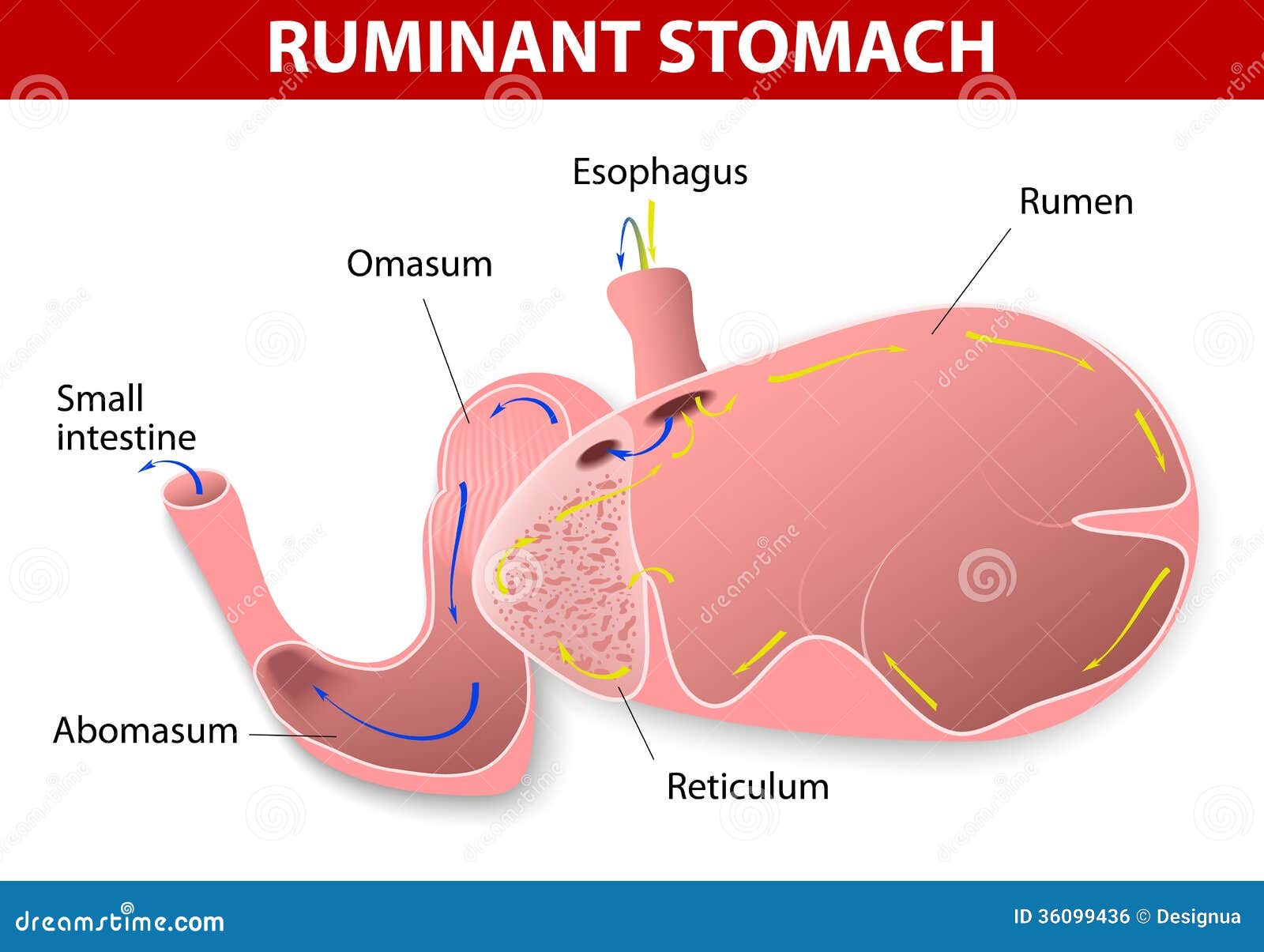
The ruminant’s stomach has four compartments: the rumen, reticulum, omasum and abomasum. 
https://thumbs.dreamstime.com/z/ruminant-stomach-species-have-one-divided-four-compartments-rumen-reticulum-omasum-abomasum-36099436.jpg 

Rumen: this is the first and largest compartment of the stomach. After a ruminant feeds, food initially collects in the rumen. The rumen is saclike, thin walled and lined with numerous projecting papillae that increases its absorptive surface area. The rumen has highly vascularized connective tissue covered by stratified squamous epithelium. The epithelium is involved in the absorption of short-chain fatty acids (i.e. sodium salts, the microbial breakdown products of cellulose). This transepithelial transport is highest in areas where the cells appear to be swollen (Kwan, P.). Muscularis mucosae are absent in this part of the forestomach. The muscularis external contains two layers of smooth muscle fibers. Myenteric plexus can be found between these layers. (Kwan, P.). The rumen serves as a large holding and fermentation vat (Kardong, 2002). Fermentation of cellulose is done by microbes in the rumen that breakbreak down plant cell walls into their carbohydrate fractions and produce volatile fatty acids (VFAs), such as acetate (used for fat synthesis), priopionate (used for glucose synthesis), and butyrate from these carbohydrates. The animal later uses these VFAs for energy(The beef site, 2009).
  Later, food in the rumen is regurgitated back into the mouth, remasticated and swallowed again. The process is repeated until there has been thorough break down of plant material (mastication) and chemical attack on cellulose (fermentation; Kardong, 2002).
The ruminant rumen from veterinary histology

Reticulum: this is the most cranial part of the stomach and food and sometimes objects drops in here first. The reticulum consists of mucosa, submucosa, tunica muscularis and serosa. The reticular walls are lined with mucous membranes that are organized in folds (laminae) to form a honeycomb pattern. On the laminae are short conical projections called papillae. The lamina epithelial is keratinized stratified squamous epithelim. Contractions of the honeycomb cells, with the purse-string action of the smooth muscle strands, help the mechanical digestion of the ingesta. The reticulum contracts to slosh the ingesta between itself and the rumen (Kardong, 2002).

Reticulum, uploaded from Veterinary Histology

Omasum: this is the third portion of the system that ingesta pass through in the ruminant. It is spherical in shape and located to the right of the rumen and reticulum, as well as being the smallest of the four compartments. The inside walls are covered in muscular laminae that are studded with short papillae. The mucosa and portions of muscularis mucosae form parallel folds that resemble pages of an open book. The mucosal surface is covered by stratified squamous epithelium. The core of the laminae are quite characteristic with three layers of smooth muscle. Extending upward from the muscularis mucosae are fibers that form the two outer layers. The orientation of the muscle cells is parallel to the free edge of the laminae. Sandwiched between these two layers is a single inner layer of smooth muscle. This is derived from the muscularis externa and the fibers are perpendicular to those of the outer layers. The omasum operates like a two phase machine. First, there is relaxation of the muscular walls which aspirates fluids and fine particles from reticulum into the omasum (Kardong, 2002). Second, the omasum contracts to force the digesta into the abomasum. The omasum absorbs volatile fatty acids, ammonia and water and at the same time separates the fermenting content of the rumen and reticulum from the highly acidic content of the abomasum (Kardong, 2002).
omasum from veterinary histology
Abomasum: this is the fundic part of the stomach in which further digestion occurs before digesta pass to the intestine. It is the glandular portion of the ruminant stomach and its histology is highly similar to that of monogastric animals. The lumen of the glandular stomach is lined with simple columnar mucus-secreting epithelium. The mucosa is thrown up into longitudinal folds called rugae which stretch flat as the stomach distends. The lamina propria is a loose connective tissue layer rich in capillaries and lymphoid cells and is entirely occupied by glands, the gastric glands (Kardong, 2002). The abomasum produces hydrochloric acid and digestive enzymes, such as pepsin (breaks down proteins), and receives digestive enzymes secreted from the pancreas, such as pancreatic lipase (breaks down fats). These secretions help prepare proteins for absorption in the intestines. The pH in the abomasum generally ranges from 3.5 to 4.0. The chief cells in the abomasum secrete mucous to protect the abomasal wall from acid damage (Kardong, 2002).

abomasum showing the rugi. From Veterinary histology

Pathology of the stomach


  • Ruminal Paraketosis is a disease of cattle and sheep characterized by hardening and enlargement of the papillae of the rumen. It is most common in animals fed a high-concentrate ration during the finishing period. Affected papillae contain excessive layers of keratinized epithelial cells, particles of food, and bacteria. Ruminal parakeratosis may be prevented by finishing animals on rations that contain unground ingredients in the proportion of 1 part roughage to 3 parts concentrate (Merck Manuals, 2015).
  •   Simple Gastritisbloating is a form of gastritis in ruminants. It involves the inflammation of the rumenoreticulum with the gases of fermentation, either in the form of a persistent foam mixed with the ruminal contents, called primary or frothy bloat, or in the form of free gas separated from the ingesta, called secondary or free-gas bloat (Merck Manuals, 2015).
  •  Omasitis; Inflammation of the Omasum. This condition may be brought about by an irritant in the food being compressed between the leaves of the omasum, and thus brought into close contact with its mucous membrane. This organ, however, appears to be very resist ant to irritants, and it is not easily inflamed. Omasitis may occur as a result of poisoning, with such irritants as yew, rhododendron, bracken, and arsenic (Book upstairs, 2011).


References 

Books Upstirs (2011). Diseases of the stomach in ruminants. Retrieved from http://www.booksupstairs.com/Veterinary-Medicine/Diseases-of-the-Stomach.html

BVetMed1 (18 March 2013). Ruminant GIT Physiology and Histology. Retrieved from http://bvetmed1.blogspot.ca/2013/03/ruminant-git-physiology-and-histology.html

Kardong, K. V. (2002). Vertebrates Comparative Anatomy, Function and Evolution. New York, NY: McGraw-Hill 

Kwan, P. (n.d). Digestive system II: esophagus and Stomach. Retrieved from http://ocw.tufts.edu/data/4/531950.pdf

The Beef Site (22 August 2009). Understanding the Ruminant’s Animal’s Digestive System. Retrieved from http://www.thebeefsite.com/articles/2095/understanding-the-ruminant-animals-digestive-system/

The Merck Vertinary Manual (2015). Bloat in ruminants. Retrieved from http://www.merckvetmanual.com/mvm/digestive_system/diseases_of_the_ruminant_forestomach/bloat_in_ruminants.html

Veterinary Histology (2006), accessed 24 October 2016, http://www.vetmansoura.com/Histology/Digestive/Digestive1.html

webb, S. D. (1998b). Hornless ruminants. Evolution of Tertiary mammals of North America, 1 (463-476).